 Wonderful Peace
Come, Thou Fount of Every Blessing
Hear this hymn on the organ or piano in the Wonderful Peace app.
- Come, Thou Fount of every blessing, Tune my heart to sing Thy grace; Streams of mercy, never ceasing, Call for songs of loudest praise. Teach me some melodious sonnet, Sung by flaming tongues above; Praise the mount! I’m fixed upon it, Mount of Thy redeeming love.
- Here I raise mine Ebenezer; Hither by Thy help I’m come; And I hope, by Thy good pleasure, Safely to arrive at home. Jesus sought me when a stranger, Wandering from the fold of God; He, to rescue me from danger, Interposed His precious blood.
- O to grace how great a debtor Daily I’m constrained to be! Let Thy goodness, like a fetter, Bind my wandering heart to Thee. Prone to wander, Lord, I feel it, Prone to leave the God I love; Here’s my heart, O take and seal it, Seal it for Thy courts above.
Words as printed in old hymnals, free for anyone to sing and share. Checked word for word against an old printed hymnal: Methodist Hymnal 1905 #19.
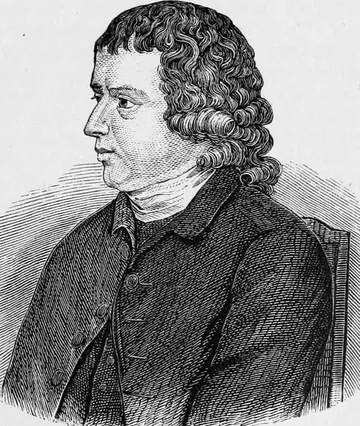
Engraving, 1875
The story behind the hymn
Robert Robinson was born in England in 1735. At fourteen he was sent to London to learn the trade of a hairdresser, and there he fell in with a rough crowd.
In May of 1752, when he was sixteen, he went to hear the famous preacher George Whitefield. The sermon stayed with him, and for nearly three years he wrestled with it, until at last, in December of 1755, he found peace with God.
In 1758, at just 22 years of age, he wrote “Come, Thou Fount of Every Blessing.” The line “Here I raise mine Ebenezer” comes from the book of First Samuel, where Samuel set up a stone and said, “Hitherto hath the Lord helped us.” Robinson knew his own heart well, and wrote honestly that he was “prone to wander.”
He became a Baptist pastor in Cambridge and served there for the rest of his life. A story told in a book many years after his death says a woman on a stagecoach once sang his hymn to him, not knowing who he was. Whether or not that is so, the hymn has helped many wandering hearts pray, “Here’s my heart, O take and seal it.”